universal Origin
Daniel
/Dan′iel/
“God is my judge”

/Dan′iel/
“God is my judge”
Highest density
over ten million individuals across 201 countries carry the name Daniel. While around a quarter million Ghanaians use the name, it maintains its highest statistical density in Switzerland where it ranks fourth. It occupies a top-ten slot in territories as disparate as the Åland Islands and Bolivia, demonstrating a rare linguistic saturation that crosses continental divides without losing its phonetic core.
The name derives from the Hebrew Daniyel, a compound of the root dan and the theophoric suffix El. It functions as a legalistic declaration: God is my judge. Early Greek transcriptions rendered it as Dalouia, while alternate Hebrew forms like Kil'av appear in early manuscripts. The mechanics of the name rely on this judicial root, anchoring the individual to a divine authority through a simple two-syllable structure.
Biblical history records Daniel as the second son of King David, born to Abigail in Hebron. His life represents a specific political reality; born into a royal household defined by fratricide and succession wars, Daniel remains a secondary figure in the text. Unlike his brothers Absalom and Adonijah, who sought the throne through violence, Daniel’s narrative is one of quietude. He represents the human cost of dynastic politics—a prince who exists in the shadow of more volatile siblings.
Data shows around two million bearers in South America, making it the name's primary stronghold. Western Europe follows with around two million bearers, while North America holds around two million. In Africa, the name appears around a million times, with Ghana and Kenya providing the highest concentrations. Its presence in 201 countries suggests it has moved beyond religious utility to become a standard bureaucratic identifier across global registry systems.
“Daniel maintains a persistent presence in top-tier naming charts, holding the 15th position in the United States and the 4th in Switzerland. Its usage is not expanding into new territories but rather consolidating in existing ones. It functions as a safe-harbor name—statistically common enough to ensure anonymity while remaining culturally legible across the Western and African hemispheres. It is a name of administrative stability, resistant to the cycles of trendy nomenclature.”
The second son of King David, born to Abigail the Carmelitess in Hebron.
Chileab was the second son of King David, born during his reign in Hebron to Abigail, the widow of Nabal the Carmelite. He is referred to as Chileab in the book of 2 Samuel and as Daniel in the genealogies of 1 Chronicles. Unlike his brothers Amnon, Absalom, and Adonijah, Chileab plays no recorded role in the political intrigues or succession crises of the Davidic monarchy, leading to the presumption that he may have died young or lived a quiet life.
Hover to read full bio
Daniel was a priest of the line of Ithamar who returned from the Babylonian exile to Jerusalem with Ezra.
Daniel is mentioned in Ezra 8:2 and Nehemiah 10:6 as a priest who returned to Jerusalem from the Babylonian exile. In Ezra 8:2, he is listed among the descendants of Ithamar, one of Aaron's sons, indicating his priestly lineage. This Daniel was part of the group that returned to Jerusalem with Ezra, who led a significant return of exiles during the reign of King Artaxerxes of Persia. In Nehemiah 10:6, Daniel is mentioned again as one of the priests who signed the covenant to follow the Law of God. This covenant was made after Ezra had read the Book of the Law to the people, and they had confessed their sins and committed to obeying God's commands. The fact that Daniel is mentioned in both Ezra and Nehemiah suggests that he played a role in the religious life of the Jewish community after the exile. As a priest, he would have been involved in the Temple service and in teaching the people the Law of God. It is important to note that this Daniel is a different person from the more well-known prophet Daniel, who lived earlier during the Babylonian exile.
Hover to read full bio
Daniel was a Jewish prophet of noble descent who lived in Babylon during the exile, renowned for his wisdom, faithfulness to God, and ability to interpret dreams and visions.
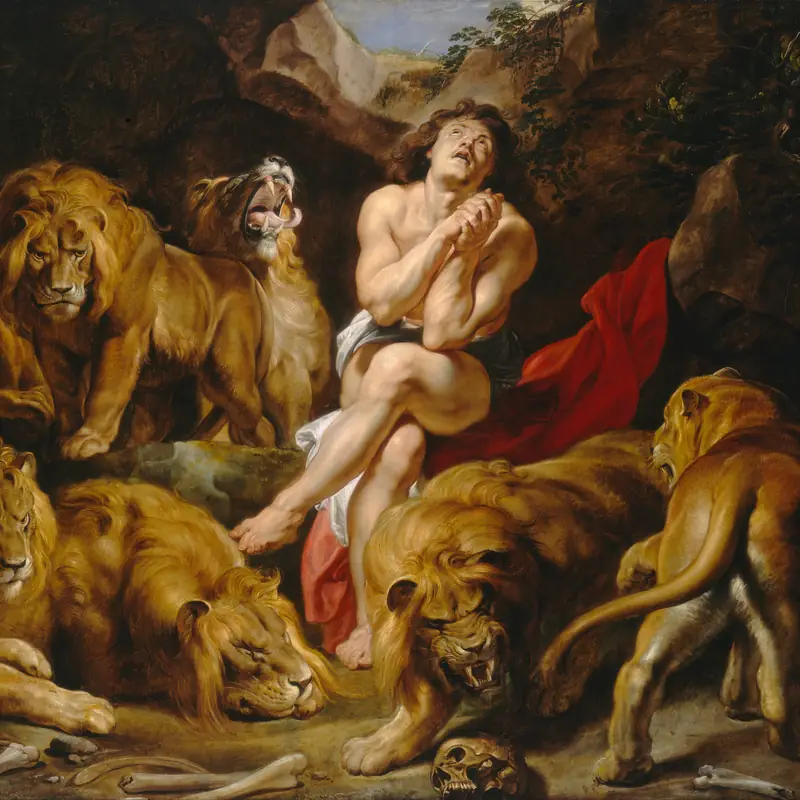
Daniel is the central figure of the Book of Daniel, which portrays him as a young man of Jewish nobility taken into captivity in Babylon by Nebuchadnezzar II. Along with his companions Hananiah, Mishael, and Azariah (renamed Shadrach, Meshach, and Abednego), Daniel was trained for service in the royal court. He distinguished himself through his wisdom and strict adherence to Jewish law, famously refusing the king's food. Daniel's God-given ability to interpret dreams brought him to prominence, most notably when he interpreted Nebuchadnezzar's dreams of a great statue representing successive world empires and a great tree symbolizing the king's own fall and restoration. He later interpreted the mysterious handwriting on the wall for King Belshazzar, predicting the imminent fall of Babylon to the Medes and Persians. Under the subsequent reign of Darius the Mede, Daniel's high position and piety provoked jealousy among other officials, who tricked the king into issuing a decree forbidding prayer to any god or man but the king. For defying this edict by praying openly to God, Daniel was thrown into a den of lions, but he was miraculously saved. The latter half of the Book of Daniel records a series of complex apocalyptic visions he received, concerning the future struggles of Israel and the ultimate establishment of God's eternal kingdom. While many scholars view the character as a legendary figure, Daniel is revered in Abrahamic religions as a model of righteousness and faith in the face of persecution.
Hover to read full bio
Click on any name to explore their story. Line thickness shows connection strength.