universal Origin
Joseph
/Jo′seph/
“may he add”

/Jo′seph/
“may he add”
Highest density
More than 35.6 million individuals currently bear the name Joseph or its direct linguistic equivalents across 201 countries. While it ranks as the second most popular name in Italy with 1.7 million bearers, it appears in much smaller, concentrated pockets like Dominica, where only 483 men hold the name. This scale suggests a saturation that transcends specific political or linguistic borders, appearing in the top 100 lists of 39 different nations.
Joseph originates from the Hebrew verb yasaf, meaning to add or increase. The specific construction Yosef functions as a jussive, translating to may he add. This linguistic root reflects a petition for expansion. In the Septuagint, the name transitioned into the Ancient Greek Ioseph, a phonetic approximation that preserved the initial semitic sounds while adapting to Hellenistic grammatical structures. During his tenure in Egypt, the figure received the name Tzafnat Paneakh, a distinct Egyptian title likely relating to the sustenance of life.
The narrative of the eleventh son of Jacob centers on systemic family collapse and subsequent administrative recovery. After his brothers conspired to kill him and ultimately sold him into slavery for twenty pieces of silver, Joseph navigated the Egyptian penal system to reach the position of vizier. His primary contribution was logistical; he managed a national grain reserve that prevented total societal collapse during a seven-year famine. The story highlights the transition from a nomadic pastoralist to a high-ranking bureaucrat.
South America hosts the highest concentration of the name, accounting for 10.9 million bearers. In Peru, Venezuela, and Panama, it maintains the #2 position for males. Western Europe follows with 4.4 million individuals, driven largely by Italy and Spain. Despite its Hebrew origins, the name shows significant penetration in Sub-Saharan Africa, where it ranks #3 in Uganda and #4 in Tanzania, indicating widespread adoption following colonial and missionary expansions in the 19th and 20th centuries.
“Joseph remains a structural staple in national registries rather than a trend-driven choice. In the United States, it holds the #13 position, showing a slight decline from its historical peak but maintaining a higher floor than more volatile names. In Italy and much of Latin America, it remains a top-tier selection, functioning as a standard administrative identifier. The name current trajectory is one of stability in traditional strongholds and slow growth in developing administrative regions.”
The eleventh son of Jacob and Rachel who, after being sold into slavery, rose to become the vizier of Egypt and saved his family from famine.
Joseph is a central figure in the Book of Genesis, the favorite son of the patriarch Jacob and his wife Rachel. His story is one of the most detailed narratives in the Hebrew Bible, describing how his brothers' jealousy led them to sell him into slavery in Egypt. Despite facing false accusations and imprisonment in the house of Potiphar, Joseph's God-given ability to interpret dreams eventually brought him before Pharaoh. He successfully interpreted Pharaoh's dreams regarding seven years of abundance followed by seven years of famine, leading to his elevation as the second-in-command over Egypt. As vizier, Joseph administered the grain supply that saved Egypt and the surrounding regions, including his own family, from starvation. He eventually revealed his identity to his brothers, reconciled with them, and settled the Israelite family in the land of Goshen. His life is often viewed as a bridge between the era of the Patriarchs in Canaan and the formation of the Israelite nation in Egypt. In Islamic tradition, he is known as the prophet Yusuf, and his story is recounted in detail in Surah 12 of the Quran.
Hover to read full bio
A member of the tribe of Issachar and the father of the spy Igal.
Joseph is a minor biblical figure mentioned briefly in the Book of Numbers. He is identified as a member of the tribe of Issachar and the father of Igal. His son, Igal, was selected as one of the twelve spies sent by Moses to scout the land of Canaan. Unlike the patriarch Joseph (son of Jacob), this individual plays no active role in the biblical narrative beyond his genealogical connection to the spy Igal.
Hover to read full bio
Joseph, a son of the Levitical musician Asaph, was a temple musician appointed to service during King David's reign.
Joseph was one of the sons of Asaph, a prominent Levite and chief musician appointed by King David to lead worship. Mentioned in 1 Chronicles 25, Joseph and his brothers were set apart for the ministry of prophesying with lyres, harps, and cymbals under their father's direction. In the organization of the temple musicians into 24 divisions by casting lots, Joseph was chosen to head the first division, highlighting his significance among the skilled singers.
Hover to read full bio
An Israelite from the family of Bani who was listed among those who had married foreign wives during the reforms of Ezra.
Joseph is mentioned in Ezra 10:42 as one of the Israelites who had married a foreign woman during the post-exilic period. After the return from Babylonian captivity, the scribe Ezra led a religious reform in Jerusalem. It was discovered that many Israelite men had intermarried with the people of the surrounding lands, which was contrary to God's law. In response, the people made a covenant to separate from their foreign wives and children. Joseph, a descendant of Bani, is recorded in the list of men who agreed to this covenant.
Hover to read full bio
Joseph was the head of the priestly family of Shebaniah during the high priesthood of Joiakim.
Joseph is mentioned in Nehemiah 12:14 as the head of the priestly family of Shebaniah during the days of Joiakim, the high priest. This was during the post-exilic period in Jerusalem when the community was being reorganized after the return from the Babylonian exile. The chapter lists the heads of the priestly families who served in the generation following the initial return, underscoring the continuity and legitimacy of the priesthood. Joseph's inclusion in this genealogical record confirms his role as a recognized leader within the restored temple service.
Hover to read full bio
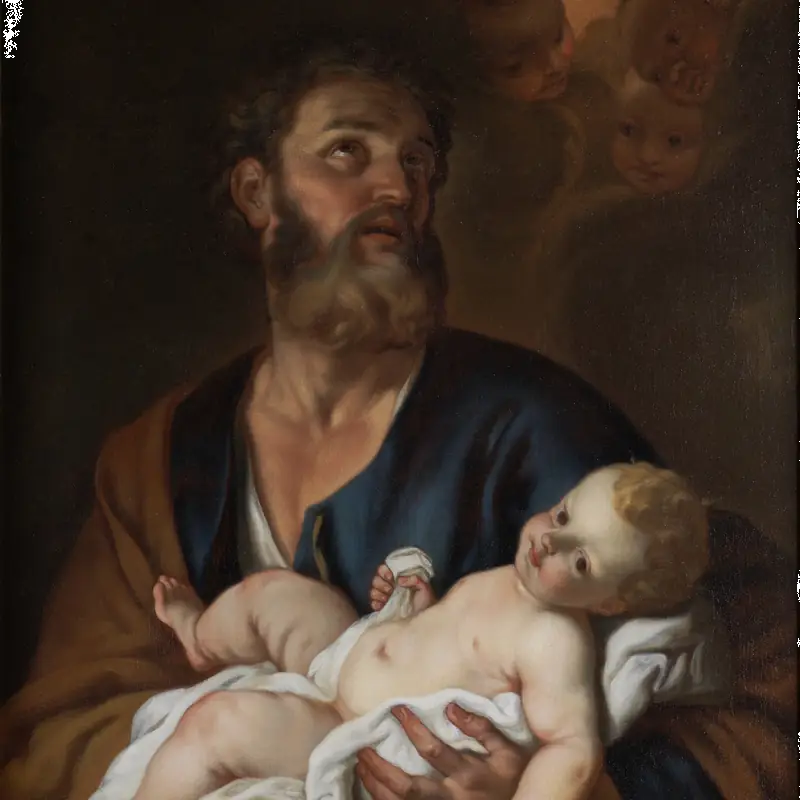
Joseph was the husband of the Virgin Mary and the legal father of Jesus.
Joseph was a 1st-century Jewish man from Nazareth and a descendant of King David. According to the gospels of Matthew and Luke, he was betrothed to Mary when he learned she was pregnant with a child conceived by the Holy Spirit. Initially planning to divorce her quietly to avoid public shame, Joseph was visited by an angel in a dream who confirmed the divine nature of the pregnancy and instructed him to take Mary as his wife and name the child Jesus. A righteous and obedient man, Joseph protected his family, guiding them to Bethlehem for the census where Jesus was born, leading them to Egypt to escape King Herod's massacre of the infants, and eventually settling them in Nazareth. As a craftsman, traditionally a carpenter, Joseph taught his trade to Jesus. He is last mentioned in the biblical narrative when Jesus was twelve years old and the family traveled to Jerusalem for Passover. It is widely presumed that Joseph died before Jesus began his public ministry, as he is not mentioned during the wedding at Cana or the Crucifixion, where Jesus entrusts his mother to the care of the apostle John. Joseph is venerated as a saint in many Christian traditions for his faith, humility, and role as the faithful guardian of the Redeemer.
Hover to read full bio
Joses, also referred to as Joseph, is identified in the Gospels as one of the four named brothers of Jesus.
Joses is mentioned as a brother of Jesus in the Gospels of Mark (6:3) and Matthew (13:55), alongside his other brothers James, Simon, and Judas. In these passages, the people of Nazareth identify Jesus as "the carpenter's son" and question his wisdom by referencing his familiar family members, including his mother Mary and his brothers. While Mark's Gospel uses the name Joses, some important manuscripts of Matthew's Gospel use the more common name Joseph, leading many translations to render it as such. This has led to the common scholarly understanding that Joses is a variant or shorter form of Joseph. Christian tradition is divided on the exact nature of this relationship; while some traditions hold that Joses and the others were biological children of Mary and Joseph, others, such as the Catholic and Orthodox churches, maintain that they were either step-brothers from a previous marriage of Joseph or cousins, a view that supports the doctrine of the perpetual virginity of Mary.
Hover to read full bio
Caiaphas was the Jewish high priest who is said to have organized the plot to kill Jesus and presided over his trial before the Sanhedrin.
Joseph Caiaphas was the Jewish high priest from approximately AD 18 to 36, a period that included the ministry of Jesus and the beginnings of the early church. Appointed by the Roman prefect Valerius Gratus, his unusually long tenure suggests he maintained a stable working relationship with Roman authorities, including Pontius Pilate. As the son-in-law of the powerful former high priest Annas, Caiaphas was a leading figure among the Sadducees, the priestly aristocracy in Jerusalem. In the New Testament Gospels, Caiaphas is portrayed as a primary antagonist of Jesus. He is credited with the political calculation that it would be better for one man to die for the people than for the entire nation to perish, thereby initiating the formal plot to have Jesus killed. He presided over the Sanhedrin trial of Jesus, charging him with blasphemy, and subsequently delivered him to the Roman governor for execution. Later, in the Book of Acts, Caiaphas is also involved in the persecution of the apostles Peter and John.
Hover to read full bio
Joseph of Arimathea was a wealthy disciple of Jesus and a member of the Sanhedrin who buried Jesus's body in his own tomb.
Joseph of Arimathea was a rich and respected member of the Sanhedrin, the Jewish council, who was a secret disciple of Jesus. Following Jesus's crucifixion, he courageously asked Pontius Pilate for permission to take Jesus's body. Along with Nicodemus, Joseph wrapped the body in fine linen with spices and laid it in his own new, unused tomb that had been carved out of rock. This act fulfilled the prophecy of Isaiah that the Messiah would be buried "with the rich in his death" (Isaiah 53:9). His actions, performed hastily before the Sabbath began, demonstrated profound reverence and bravery at a time when Jesus's other followers were in hiding.
Hover to read full bio
Joseph, the son of Mattathias, is listed as an ancestor of Jesus Christ in Luke's genealogy.
Joseph, son of Mattathias, is an individual mentioned in the Gospel of Luke as part of the genealogy of Jesus Christ. This lineage, which traces Jesus' ancestry back to Adam, lists Joseph as the son of Mattathias and the father of Jannai. His inclusion in the genealogy is significant as it establishes Jesus' connection to the ancestral line of David, a key element in fulfilling messianic prophecies. Beyond his position in this ancestral list, no other details about his life or the specific historical period in which he lived are provided in the biblical text.
Hover to read full bio
Josech, also known as Joseph, is an ancestor of Jesus Christ mentioned in the genealogy of the Gospel of Luke.
Josech is a figure mentioned in the New Testament in the genealogy of Jesus Christ recorded in Luke 3:26. He is identified as the son of Joda and the father of Semein. The genealogy in Luke traces Jesus' lineage through his maternal line back to Adam, and Josech's inclusion serves to establish this ancestral connection. Beyond this genealogical reference, no further details about his life, the specific time period in which he lived, or his actions are provided in the biblical text. The name itself is considered a variant of "Joseph," and different Bible translations may use "Josech," "Josek," or "Joseph" in this verse.
Hover to read full bio
Joseph, the son of Jonam, is an ancestor of Jesus Christ listed in the genealogy found in the Gospel of Luke.
Joseph, son of Jonam, is mentioned in Luke 3:30 within the genealogy of Jesus Christ. This lineage traces Jesus's ancestry back to Adam, establishing his connection to the Davidic line as foretold in messianic prophecies. Joseph is listed as the son of Jonam and the father of Judah. Beyond his place in this ancestral list, no further details about his life or the specific historical period in which he lived are provided in the biblical text. His sole significance is his role in the genealogical record demonstrating Jesus's human heritage.
Hover to read full bio
Joseph, called Barsabbas and surnamed Justus, was a disciple of Jesus and one of the two candidates proposed to replace Judas Iscariot as an apostle.
Joseph Barsabbas, also known by the Latin name Justus, was a prominent early follower of Jesus mentioned in the Acts of the Apostles. He had been a disciple throughout Jesus's entire public ministry, from the baptism of John until the Ascension. Because of this, he was one of two men, along with Matthias, nominated to replace Judas Iscariot among the Twelve Apostles. After the disciples prayed for divine guidance, they cast lots, and the lot fell to Matthias, who was then numbered with the eleven apostles. Though not chosen, Joseph's nomination indicates the high regard in which he was held within the early Christian community. Later traditions identify him as one of the seventy-two disciples sent out by Jesus in the Gospel of Luke. The church historian Eusebius, citing the earlier writer Papias, recounts a tradition that Joseph Barsabbas drank a deadly poison without suffering any harm.
Hover to read full bio
Barnabas was a Cypriot Levite and a prominent early Christian disciple who vouched for the Apostle Paul and accompanied him on his first missionary journey.
Barnabas, born Joseph, was a Levite from Cyprus and a leading figure in the early Christian church. He demonstrated immense generosity by selling a field he owned and donating the proceeds to the apostles in Jerusalem. Barnabas played a pivotal role in the acceptance of Paul the Apostle, vouching for the former persecutor before the apostles and bringing him from Tarsus to minister to the growing church in Antioch. Together, Paul and Barnabas undertook the first missionary journey, preaching in Cyprus and Anatolia and establishing new Christian communities. He participated in the Council of Jerusalem, which addressed the inclusion of Gentiles into the church. A sharp disagreement with Paul over whether to take his cousin John Mark on a second journey led to their separation; Barnabas then continued his ministry with Mark in Cyprus. Though not one of the original twelve, he is referred to as an apostle in Acts 14:14 and was highly esteemed for his encouraging and supportive nature.
Hover to read full bio
Click on any name to explore their story. Line thickness shows connection strength.