universal Origin
Mary
/Ma′ry/
“their rebellion”

/Ma′ry/
“their rebellion”
Highest density
Fifty-six million women currently carry the name Mary, a population roughly equivalent to the entire nation of South Africa. In Brazil alone, 13.4 million individuals answer to it, ranking it the second most frequent female name in the country. This massive scale masks a linguistic root that suggests friction rather than the serenity often attributed to the figure. While it appears in 202 countries, its density is highest in Latin America, where Mexico and Argentina also report it as their #2 most common name.
The name originates from the Hebrew Miryam. Linguists trace the construction to the root 'marah', meaning bitterness, or 'mery', signifying rebellion. The 'am' suffix translates to 'their', resulting in the literal meaning 'their rebellion'. The name transitioned into Ancient Greek as Mariám and María, dropping the terminal 'm' to accommodate Hellenistic grammatical rules. The popular association with the sea, or 'stella maris', is a late linguistic development resulting from a medieval transcription error rather than the original Hebrew mechanics.
The primary bearer, Mary of Nazareth, existed in a high-stakes political environment in first-century Judea. As an unwed pregnant woman in a strict honor-shame culture, she faced the immediate risk of social exile or capital punishment. Her narrative is defined by displacement and state-level conflict, including a flight to Egypt to evade a government-ordered infanticide. The biblical text mentions her in 49 verses, documenting her presence from the birth of Jesus to his execution, framing her life through the lens of survival under Roman occupation.
Mary is distributed across 202 countries, with South America housing the highest concentration at 18.9 million bearers. In North America, Mexico accounts for 12 million of the 15.8 million total. The name maintains a significant presence in the Middle East with 4.6 million bearers, specifically ranking #8 in Iran and #16 in Iraq. In Africa, the name holds the #2 spot in Angola, Namibia, and Cabo Verde, reflecting the historical movement of Portuguese and German naming conventions across the continent.
“Mary remains a statistical staple in the Southern Hemisphere while fading as a primary choice for newborns in Western Europe and the United States. In the U.S., it currently ranks at #9, sustained by older generations rather than a surge in new births. The name has transitioned from a default naming convention to a specific marker of traditionalism. Its current status is defined by its utility as a middle name or a component of hyphenated identities, ensuring its numerical dominance even as its popularity as a standalone first name plateaus.”
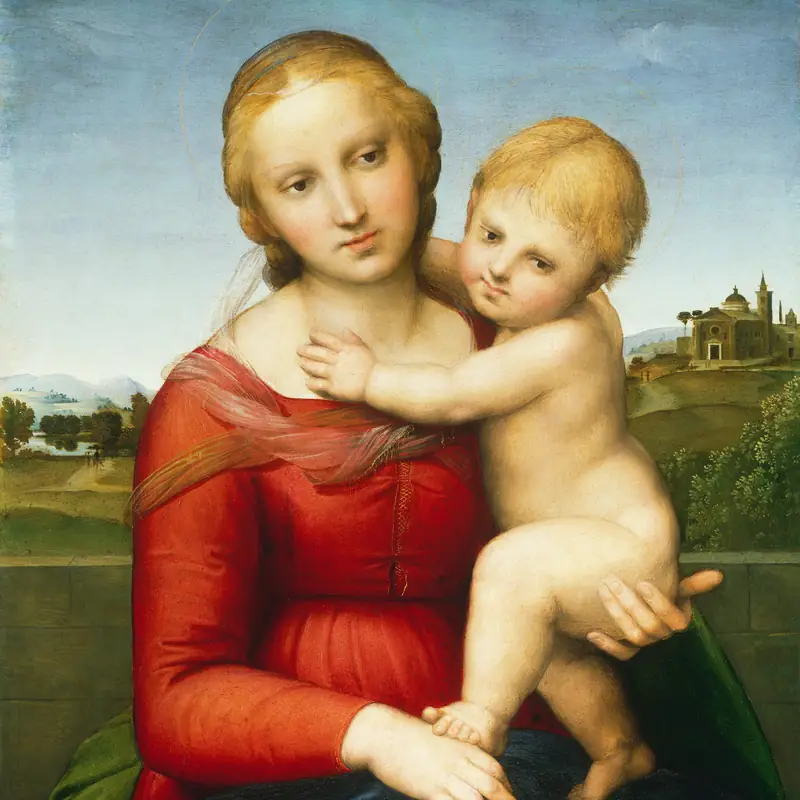
Mary was a first-century Jewish woman of Nazareth, who was the wife of Joseph and the mother of Jesus Christ.
Mary, a young Jewish woman from Nazareth, was betrothed to Joseph when the angel Gabriel announced that she would miraculously conceive a son by the Holy Spirit, who was to be named Jesus. Accepting God's will, she became the mother of the Messiah, fulfilling Jewish prophecy. The Gospels of Matthew and Luke describe her giving birth to Jesus in Bethlehem, raising him in Nazareth, and being present at the beginning of his public ministry and at his crucifixion in Jerusalem. After Jesus's ascension, she is mentioned as being with the apostles in prayer. While the Bible does not record her later life or death, Christian traditions, particularly in the Catholic and Orthodox churches, hold that she was assumed bodily into heaven, an event known as the Assumption or Dormition.
Hover to read full bio
Mary Magdalene was a prominent female disciple of Jesus, a witness to his crucifixion, and the first person to see him after his resurrection.
Mary Magdalene was a Jewish woman from the Galilean town of Magdala who, according to the four canonical gospels, traveled with Jesus as one of his followers. She is named as a witness to his crucifixion and burial and was the first person to see him after the resurrection. The gospels state that seven demons had been driven out of her. For centuries in Western Christianity, she was incorrectly conflated with Mary of Bethany and the unnamed "sinful woman" who anointed Jesus' feet, leading to a popular but unsupported belief that she was a repentant prostitute. This conflation was formally corrected by the Catholic Church in 1969. She is a central figure in later Gnostic Christian writings, where she is portrayed as Jesus's most beloved disciple who uniquely understood his teachings. In modern times, she is venerated as a major saint by Catholic, Orthodox, Anglican, and Lutheran churches, and is honored by many other Protestants. In 2016, the Catholic Church elevated her memorial to a feast, giving her the title "Apostle of the Apostles" in recognition of her role as the first to announce the resurrection to the male apostles.
Hover to read full bio
Mary of Bethany is a New Testament figure, sister of Martha and Lazarus, who is depicted as a devoted disciple of Jesus.
Mary of Bethany, along with her siblings Martha and Lazarus, lived in Bethany and were close friends of Jesus. She is presented in the Gospels as a contemplative figure, most notably when she sat at Jesus' feet to listen to his teachings while her sister Martha was busy with preparations, a choice Jesus commended as "the better part". Mary also plays a central role in two other key narratives: the raising of her brother Lazarus, where her profound grief and faith deeply move Jesus; and the anointing of Jesus' feet with expensive perfume, an act of devotion that Jesus identified as a preparation for his burial.
Hover to read full bio
Mary of Clopas was one of the faithful women who witnessed the crucifixion of Jesus.
Mary of Clopas is a figure mentioned in the New Testament as one of the women present at the crucifixion of Jesus, standing by the cross with Jesus's mother and Mary Magdalene (John 19:25). Many scholars identify her with the "Mary the mother of James and Joses" mentioned in the Gospels of Matthew and Mark, who also witnessed the crucifixion from a distance and later went to the tomb on resurrection morning. This identification, famously argued by St. Jerome, suggests she was the mother of some of those referred to as Jesus's "brothers" (who would be his cousins in this view), including the apostles James the Less and Jude. The exact nature of her relationship to Jesus's mother is debated; the phrase "his mother's sister" in John 19:25 could mean she was a literal sister, a sister-in-law (wife of Joseph's brother, Clopas), or a close relative. Her steadfast presence at the cross marks her as a loyal and courageous disciple during Jesus's darkest hour.
Hover to read full bio
Mary, the mother of John Mark, was a prominent early Christian in Jerusalem whose home served as a central meeting place for believers.
Mary was a significant figure in the nascent Christian church in Jerusalem, primarily known as the mother of John Mark, the traditional author of the Gospel of Mark. Her home was a well-known gathering place for the apostles and other disciples; when Peter was miraculously freed from prison, he went directly to her house, where many had gathered to pray for him (Acts 12:12). This indicates Mary was likely a woman of some means, able to host large groups, and deeply committed to the faith, using her resources to support the church. She was a relative of Barnabas, a prominent leader in the early church, though the exact relationship is debated, with some traditions identifying them as siblings.
Hover to read full bio
Mary of Rome was a first-century Christian woman greeted by the Apostle Paul in his Epistle to the Romans and commended for having 'bestowed much labour' on the early church community.
Mary of Rome is a Christian woman mentioned only once in the New Testament, in the Apostle Paul's greetings to the church in Rome (Romans 16:6). Paul sends his greeting to her and notes that she "bestowed much labour on us." This commendation suggests she was a significant and diligent worker within the early Roman Christian community. Beyond this brief mention, nothing definitive is known about her life or specific contributions. Various conjectures, such as identifying her with Mary, the mother of John Mark, or Mary Magdalene, are unsubstantiated and not widely accepted by scholars.
Hover to read full bio
Click on any name to explore their story. Line thickness shows connection strength.