universal Origin
Michael
/Mi′cha·el/
“who is like God?”

/Mi′cha·el/
“who is like God?”
Highest density
Nearly 16 million people carry the name Michael across 200 countries. While it ranks third in the United States with over four million bearers, its highest density occurs in the Caribbean, where it holds the number two spot in Jamaica, the Bahamas, and Grenada.
The name originates from the Hebrew Mikhael, a rhetorical interrogative meaning Who is like God? It functions as a theophoric sentence, combining the particles mi (who), ke (like), and el (God). This linguistic construction asserts divine uniqueness by implying that the answer to the question is no one. The Ancient Greek form Michael facilitated its movement into the Roman administrative world and subsequent European languages.
In the biblical record, Michael appears as a member of the tribe of Asher and the father of Sethur. The stakes for this figure were high-altitude and geopolitical; his son was one of the twelve scouts sent by Moses on a high-risk reconnaissance mission into Canaan. Michael’s legacy in this context was tied to the physical survival of his lineage during a transition from nomadic wandering to territorial conquest.
Michael maintains a dominant presence in North America with 5.4 million bearers. Beyond the United States, the name clusters in Western Europe, where it ranks fourth in Germany with close to a million individuals and third in Ireland with well over fifty thousand. South America accounts for 1.6 million bearers, showing consistent top-20 placement in Argentina, Bolivia, and Peru.
“Michael remains a high-volume staple in the West, though its peak dominance has shifted. In the United States, it held the number one spot for nearly half a century before sliding to third. It currently functions as a linguistic anchor in Eastern Europe, ranking seventh in Slovakia and twelfth in Czechia. The name persists as a default choice due to its phonetic simplicity and established administrative presence.”
An Israelite from the tribe of Asher and the father of the spy Sethur.
Michael is a minor biblical figure mentioned in the Book of Numbers during the wilderness wanderings. He is identified as the father of Sethur, who was selected as the representative for the tribe of Asher among the twelve spies sent by Moses to scout the land of Canaan. Unlike his son, Michael plays no active role in the narrative and is mentioned solely to establish Sethur's genealogy.
Hover to read full bio
An ancestor of a prominent Gadite family listed in the genealogies of the Chronicles.
Michael is a man from the tribe of Gad mentioned in the Old Testament. His genealogical record appears in 1 Chronicles 5:14, which identifies him as the son of Jeshishai and the father of Gilead. This lineage places him as an ancestor of Abihail, a chief of a Gadite ancestral house. The surrounding verses detail the settlement of the Gadites in the land of Bashan. He is one of several men named Michael listed in the Hebrew Bible, and this particular individual is distinguished by his place in the Gadite genealogy.
Hover to read full bio
Michael was a Levite of the Gershonite clan, the son of Baaseiah and an ancestor of Asaph, one of King David's chief musicians.
Michael is a figure mentioned in the Old Testament within the extensive genealogies of the tribe of Levi. Specifically, his name appears in 1 Chronicles 6:40 as the son of Baaseiah and the father of Shimea. This lineage places him as a descendant of Gershon, one of Levi's sons, and establishes him as a direct ancestor of the celebrated temple musician, Asaph. While no actions are attributed to Michael himself, his inclusion in this priestly and musical lineage is significant, underscoring the importance of hereditary roles within the Levitical service at the tabernacle and later the Temple.
Hover to read full bio
A military chief from the tribe of Issachar and one of the five sons of Izrahiah.
Michael is a biblical figure mentioned in the genealogical records of the tribe of Issachar in the Old Testament. He is identified as a son of Izrahiah and a descendant of Tola, who was a son of Issachar. The scripture in 1 Chronicles 7:3 lists him alongside his brothers Obadiah, Joel, and Isshiah, describing all of them as "chief men" or leaders within their clans. While few details about his life are provided, his inclusion in the genealogy and his designation as a chief highlight his position of authority and responsibility within his tribe.
Hover to read full bio
A Benjamite listed as one of the sons of Beriah in the genealogies of 1 Chronicles.
Michael is a man from the tribe of Benjamin briefly mentioned in the genealogical records of the Hebrew Bible. He is listed in 1 Chronicles 8:16 as one of the nine sons of Beriah, who were heads of ancestral houses in Aijalon. The text provides no further details about his life, actions, or family. His inclusion serves primarily to document the lineage of the tribe of Benjamin for the post-exilic community, establishing tribal identities and heritage.
Hover to read full bio
Michael was a military leader from the tribe of Manasseh who, along with other warriors, defected to support David at Ziklag.
Michael is mentioned in the book of 1 Chronicles as one of the warriors from the tribe of Manasseh who joined David at Ziklag while David was fleeing from King Saul. He is listed among a group of seven defectors from Manasseh described as "captains of the thousands," indicating they held significant leadership positions within their tribe's military structure. These brave warriors provided valuable support to David's forces against raiding bands. The biblical text does not provide further details about Michael's specific role or exploits, but his inclusion in the list highlights the broad support David garnered from various Israelite tribes even before he became king.
Hover to read full bio
A son of King Jehoshaphat of Judah, mentioned in the list of the king's sons in 2 Chronicles 21:2.
Michael is a son of King Jehoshaphat of Judah, listed in 2 Chronicles 21:2 alongside his brothers Azariah, Jehiel, Zechariah, Azaryahu, and Shephatiah. The biblical text states that Jehoshaphat provided for his sons with significant gifts of silver, gold, and fortified cities within Judah. However, he designated his firstborn son, Jehoram, as his successor to the throne. After this mention, Michael is not referenced again in the biblical narrative, which proceeds to focus on the reign of his brother Jehoram.
Hover to read full bio
Michael, a descendant of Shephatiah, was the father of Zebadiah, one of the family leaders who returned from Babylon to Jerusalem with Ezra.
Michael is mentioned in the Book of Ezra as a descendant of Shephatiah whose son, Zebadiah, was a head of the ancestral house. In the context of Ezra chapter 8, the priest and scribe Ezra is gathering a group of Jewish exiles in Babylon to make the journey back to Jerusalem under the decree of King Artaxerxes. A detailed genealogy is recorded of the family leaders who responded to the call. Michael is listed as the father of Zebadiah, who led a contingent of eighty males from the clan of Shephatiah on this return. No further details about Michael's own life are provided in the biblical text; his mention serves primarily to establish the lineage of his son Zebadiah, a key participant in this significant event in Israel's history.
Hover to read full bio
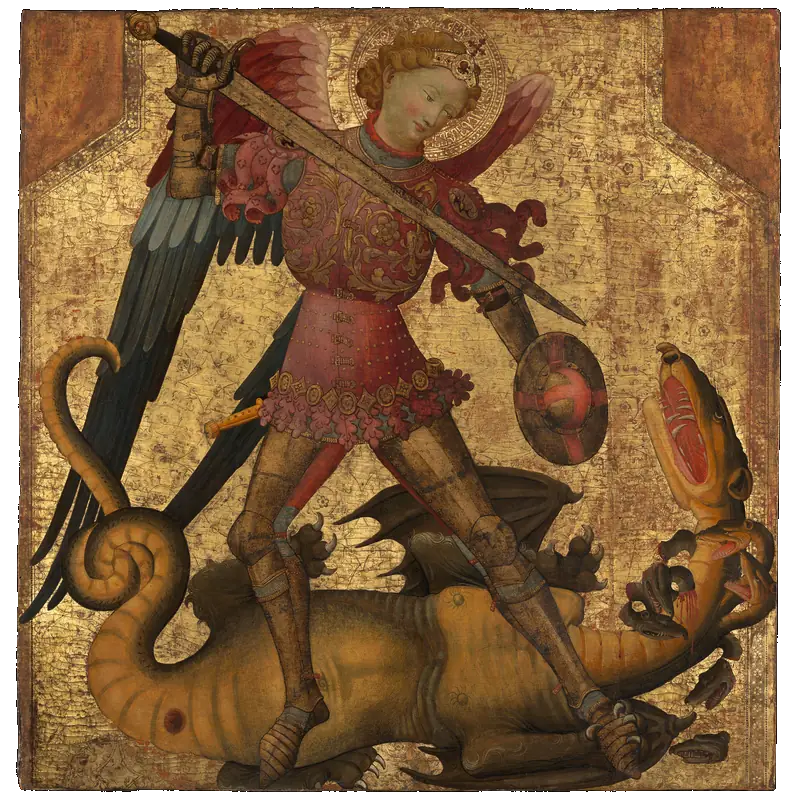
Michael is an archangel in Judaism, Christianity, and Islam, depicted as a warrior of God, a protector of Israel, and the leader of the heavenly armies in the battle against Satan.
Michael is a prominent archangel featured in the scriptures of Abrahamic religions. In the Hebrew Bible, specifically in the Book of Daniel, he is presented as a guardian prince of the people of Israel who contends with celestial princes of other nations. The New Testament builds on this tradition, with the Epistle of Jude mentioning his dispute with the devil over the body of Moses and the Book of Revelation depicting him as the commander of God's armies who leads the fight against Satan and his angels, ultimately casting them out of heaven. Across these texts, Michael is consistently portrayed as a powerful warrior angel, a defender of God's people, and a key figure in the cosmic battle against evil.
Hover to read full bio
Click on any name to explore their story. Line thickness shows connection strength.